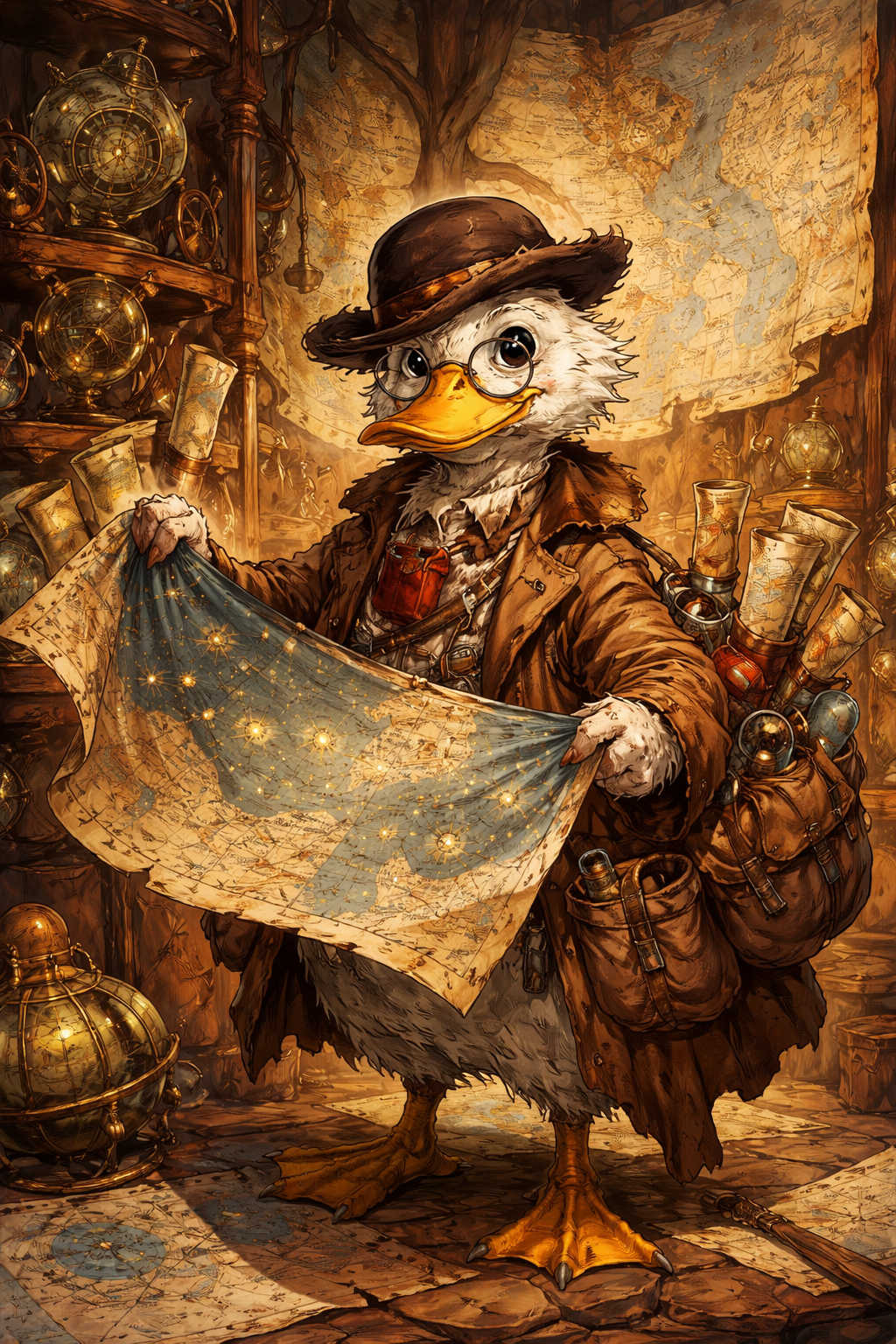
FIELD REPORT: DAY ONE 1000. A-HEM. Gather close. I have completed my review of the library materials, and I will now provide a proper, field-usable account.
I will spare you the romance. The shelves here do not hold stories.
They hold vectors. Vectors that when properly examined form the basis for the path. The path from which lies on the map. The map which we must now create.
What Stormwreck is (in the language of survival)
Everything written here circles the same truth:
Stormwreck is an island built from draconic endings.
The accounts disagree on the exact shape of those endings, which is itself instructive. When an island’s history cannot be told cleanly, it is usually because:
- the tellers are frightened,
- the tellers are lying,
- or the truth resists being handled.
Here we must assume all three.
The island’s foundational myth (and why it matters)
The central legend is of Sharruth, a red dragon who terrorized the mainland.
The story ends with metallic dragons stopping Sharruth—though witnesses cannot agree whether Sharruth was buried, imprisoned, or swallowed by the sea.
From Sharruth’s rage or death, a volcano erupts and the Stormwreck isles are born.
What this tells us:
- The land itself may be shaped by draconic power.
- The island may contain prisons, tombs, or sealed sites.
- The details are inconsistent, which suggests either unreliable lore or a deliberate veil used to conceal the truth.
Secondary draconic sites (where to put our feet)
Multiple “great dragon deaths” are recorded on or near the island. The most actionable leads are:
- Dragon’s Rest — A bronze dragon named Astalagan is memorialized in statuary. Statuary usually means a shrine, a faction, a caretaker, or a relic tradition.
- The North — Reports mention bone shards jutting from the earth. This is either a carcass site, a battlefield, or something attempting to claw its way back into relevance.
- Warmed lakes — Tales describe lakes that are unnaturally warm, tied to a dragon’s end. Heat that persists suggests lingering magic, a living source beneath, or a sealed vent.
- The “evil blue dragon” tale — There are stories of an evil blue dragon being slain. Even if false, the story points to a location that locals consider dangerous or cursed.
Cave warnings (the island’s practical violence)
This is not heroics. This is hazard management.
Night tides
Night tides are described as brutally high. The water returns to normal at certain times.
Operational rule: we do not enter sea caves at night without a clear exit plan and timing.
Stirges and “evil goop”
Stirges are confirmed. They feed on blood. They are associated with “big big evil goop,” described as something to watch for.
Operational rule: if we see unnatural slime, pooled muck, or suspicious organic residue, we assume it is a spawning ground, an ambush site, or both.
A darker thread (and why we keep our eyes open)
One account describes demon-worshipers and names Orcus, “Lord of the Undead.”
I am not claiming every shadow on Stormwreck belongs to Orcus.
I am saying that places layered with powerful deaths tend to attract scavengers—mortal and otherwise.
How we turn this into an expedition that finds what we are looking for
If our objective is hidden, we do not charge randomly. We make the island tell on itself.
Step 1: Build a trail of draconic influence.
Start at Dragon’s Rest (statuary and recorded memory). Collect references to where the dead are honored, where the dead are avoided, and where the dead are sealed.
Step 2: Follow the strongest physical evidence.
Move to the northern bone-shard site. Treat it as a compass needle.
Step 3: Use environmental anomalies as beacons.
Investigate warmed lakes and persistent heat. Heat that does not behave is almost always a door—a door to what, you say? I do not know.
Step 4: Only then, descend.
When we have a suspect site, we plan a cave approach around tides. We prepare for stirges. We treat slime as a warning glyph written in biology.
In summary: the library does not hand us a map.
It hands us a search pattern from which we must create the map. We are the map makers.
Now. If anyone would like to argue with my pattern, please do so before we are underground and bleeding.
Field Account: What Actually Happened Before I Read All Those Books
Having now provided a thorough and useful distillation of the library materials, I feel compelled to also document the events of the day in which said library was found — in service of completeness, and in service of the historical record, which deserves the truth even when the truth involves a frying pan.
Bleep and Rix — a threat assessment I immediately revised
When we passed through the gate, two kobolds were waiting for us.
I say “waiting.” They were vibrating. There is a distinction.
Their names are Bleep and Rix. They are small. They are extremely energetic. They laid eyes on Mr. Aurelian and entered a state I can only describe as draconic rapture — the man has a silver heritage, and they knew it immediately and were absolutely undone by this knowledge.
They then looked at me.
I am used to being observed. I am a duck of some distinction. But the quality of their attention was such that I felt it necessary to reach into my pack and retrieve my cast iron frying pan, with which I delivered a single, considered swat to the nearest one.
This was not violence. This was boundary-setting.
They were undeterred. I kept the pan in hand. We proceeded to Dragon’s Rest under escort.
Dragon’s Rest — the place and the people in it
Dragon’s Rest is not what you’d call inconspicuous.
We were received by Abbott Elder Rumara. She did not need to introduce herself.
The first thing I clocked upon entering was a statue of an old man, seated, with many birds around him. My eye went to it immediately. When I asked about it, I was informed that this is Bahamut — the dragon god — rendered in his human form. Dragon’s Rest has a temple to him. I found this significant and filed it accordingly.
We were also informed, with the kind of flatness that people use when they’ve had to say something too many times, that Lord Ayren is gone.
Gone is a large word when used that carefully. I noted it.
Taurak — who I have thoughts about
Taurak is a human. He is covered in tattoos. He gave us a boat later, so I want to be precise here: I am not making an accusation. I am making an observation, which is different and which is my job.
The tattoos are specific. The placement is specific. The patterns have a grammar to them that I have seen before in a context that does not involve honest employment. I have not yet confirmed which guild’s marks they are, but I am comfortable saying the aesthetic vocabulary is thieves’ work.
He was cordial. He gave us a boat.
I am still watching.
Warnof — a cleric who is furious at us personally
Warnof is a cleric. She has taken an oath of non-violence. She has a wooden leg — I could not determine the species of wood, which bothered me more than I expected.
She is mad.
Not generally mad. Specifically mad. At us. She has determined, with what I will charitably call conviction, that we brought the undead infestation to her island.
She communicated this clearly. She communicated that we would deal with the undead problem or face — and here her words took a turn — seemingly her wrath. From the woman who swore an oath against violence.
I found this architecturally impressive.
I wrote her name down with a star next to it. I do not hand out stars lightly.
Myla — a colleague of the highest possible caliber
I will say this plainly: I saw Myla across the room and ran toward her.
She appeared to be attempting the same.
We met in the middle.
Myla is a kobold. She is winged. She stands nearly five feet tall which makes her taller than me, though we are matched in all the ways that matter. She is an artificer. She dives the northern wrecks and carries the arcane debris back up from the seafloor piece by piece. The library I spent two hours cataloguing is hers.
She invited me to her workshop. I accepted before she finished the sentence.
I climbed onto her back.
She seemed delighted by this.
The crisis
We were on our way back from the workshop. I was sharing findings from Myla’s own library — which she appreciated, I believe — and the natural reciprocation was to show her my own work. I reached into my pack for the Arcane Atlas.
I reached further.
I turned the pack on its side and began to sort through its contents methodically.
The atlas was not there.
I went through the pack again. Then a third time, slower, the way you do when you are hoping the result will change. The atlas was not in the pack. The atlas has not been in the pack since — and here the timeline resolved itself with terrible clarity — since the wreck of the Compass Rose.
The Arcane Atlas is, for the record, of significant arcane value to one, Dr. Waxyl T. Feathers. Without it I am a duck with theoretical magic. A map maker without a map. A doctor without — this next part I said out loud, possibly at volume — I am not Dr. Waxyl T. Feathers without it.
I turned to the party.
I explained the situation.
I may have explained it with some urgency.
Mr. Yaz said — and I am quoting from memory — it appears our dear Dr. Feathers is not a doctor without his maps. He then said we should help. He was the supportive voice. He persuaded them.
He then mentioned, almost in passing, that he had also lost his teapot on the Compass Rose.
We all know what Mr. Yaz is without his tea.
The party agreed. We were going north.
Preparation — the finer points
Before departure, Taurak gifted us a boat. It rows itself. This is an extraordinary piece of enchantment and I intend to ask him where it came from when the time is appropriate.
He also gave us a bag of foul-smelling fertilizer. For the mushroom folk, he said, should we find ourselves near the cave he marked on a map. We accepted this without comment. Foul-smelling fertilizer has its place. I know better than to refuse a thing because it smells.
Mr. Yaz also asked, given that harpies like those we’d encountered on the Compass Rose were said to inhabit the north — whether I could create something to block their song. I produced a candle from my pack. From the candle I fabricated earplugs for the party.
Operational note: Mr. Yaz was the only one who thought to ask for this before we left. I have updated my assessment of Mr. Yaz accordingly.
The voyage north — and one sleeping dwarf
I will note for completeness that Mr. Brugan spent the entire voyage to the shipwreck asleep in the rowboat.
He carried me across the beach. He was exhausted. He earned his rest. I do not hold this against him.
He was, however, deeply asleep when everything that followed took place.
Diving operations — a participation note
The party found the wreck site and elected to dive.
There was treasure. The divers retrieved it. Good results.
I did not dive.
I want to be clear that I understand how this reads. I am a duck. Ducks are famously associated with water. The association is not wrong in a general zoological sense.
I, specifically, do not swim, and I, most certainly, do not dive. I did, however, manage to procure a rather peculiar feather of celestial origin that, when one tickles where one may not expect to, persuades the tickled to take flight. This is theoretical. We must test in the field.
Boarding the Compass Rose
Mr. Aurelian and I made our way from the rowboat onto the deck of the Compass Rose. The deck was worse than I remembered. Wood soft in places. Rigging down on the starboard side. Things had shifted or been moved. Neither option was encouraging.
Near the bow: a husk. An undead body, the kind that has been waiting longer than it had any right to. My attention went to what it was holding.
An amulet.
I recognized the description immediately — this matches what one of the Dragon’s Rest residents had described as potentially key to treating the affliction. The affliction that Ms. Mephista and Mr. Aurelian had contracted on this very ship, on the first night, in ways I have not yet fully documented. That affliction is likely why the undead on the beach targeted them specifically — the dead appear to sense it through whatever mechanism the dead use for sensing. I have noted this pattern. It recurs.
I attempted to communicate this to Mr. Aurelian.
However, ears plugged with candle wax did not work in my favor. He could not hear me.
I began to sign. I am not, technically, trained in any formal sign language system, but I have a working vocabulary of expressive gesture that I believe is reasonably legible to a patient observer. I conveyed: undead, amulet, important, retrieve. I believe I also conveyed urgency.
Then I paused, reached into my pack, and produced the grappling hook.
This is the second time I have offered this grappling hook in a relevant tactical moment. I handed it to Aurelian.
Before the hook could be deployed, Ms. Mephista appeared — from where, I cannot say — and took the amulet off the husk with her spear in a single motion.
I stand by the grappling hook. The methodology is sound and will find proper use.
The atlas — recovered
I turned my attention to the captain’s quarters.
The atlas was on the desk. Sitting there. Not lost, not damaged. Sitting on the desk of the captain’s quarters, where I had apparently set it down during the chaos of the first night and simply failed to take it when the ship was sinking.
I held it for a moment.
I did not say anything. Some reunions do not require narration.
There were also six bottles of very good wine in the cabin. I took those too. I am a professional but I am not reckless.
The undead — handled, mostly
We looked through the portholes before entering the lower decks.
The exploding kind. Several of them. I recognized the type from the beach — the ones that detonate upon dispatch, the ones that got onto Mr. Brugan’s boots and made the whole shore smell like the wrong end of biology.
I produced my magical pebbles.
The party handled them with precision. I want that noted. We are getting better at this.
One, however, got itself lodged in a porthole at an unfortunate angle and detonated outward onto the boat. Some of the party was caught in this. The smell was significant.
I remain grateful for what I have in the way of reflexes.
The lower decks — inventory
Once inside, we recovered the following:
Mr. Yaz’s teapot. He held it the way a person holds something they were not sure they’d see again. I understand this feeling.
A horn, which I noted appeared to belong aesthetically and dimensionally to Mr. Brugan — who was still asleep in the boat above us unable to confirm ownership. Sleep and absence of party members in otherwise chaotic moments remains noteworthy.
A sword, fine quality, which Mr. Aurelian claimed. It suited him. I noted this without commentary.
The body of the captain. Without her head. I recorded this without embellishment because the record does not need embellishment. Captain Peggy’s body was in the lower deck without its head, and she had in her possession a signet ring.
Mr. Yaz took the ring.
He said he wanted to return it to her family. He said it was the right thing — that someone should know what happened, that someone should have the small piece of her that the sea left behind.
I do not have a field note for that. I just wrote it down.
The ruckus above — an interpretive disagreement
While we were in the lower decks, we began to hear significant noise from the deck above us.
Combat sounds. Screaming. The particular chaos of something that does not want to be where it is and something else that is insisting.
I assessed the sound pattern and offered my professional interpretation: harpies, engaged in courtship ritual. Harpy courtship is notoriously violent — blood, feathers, screaming, the full architecture of passion. This is textbook. I have four separate academic sources on the subject and I stand by all four.
The party looked at me.
We agreed not to interfere, and exited through the portholes.
Exit — and what followed us
We rowed.
We cleared the wreck by a hundred feet, maybe more. The noise from the ship continued behind us, muffled by distance and water.
Then: a splash. Large. Something had gone into the water off the ship.
I leaned over the side of the boat and put my head under the surface.
Through the dark water, walking along the seafloor, moving with the particular direction of something that has a destination and does not intend to stop —
A hulking undead shape.
Heading toward us.
I pulled my head out of the water.
The atlas is back in my pack. Mr. Yaz has his teapot. Ms. Mephista has the amulet. Mr. Brugan is still asleep.
And something very large is walking toward us along the bottom of the sea.
We proceed.
— Dr. Waxyl T. Feathers Field Correspondent, The Nest Stormwreck Expedition, Day 1 1000